Mechanisms of drag reduction by semi-dilute inertial particles in a turulent channel flow
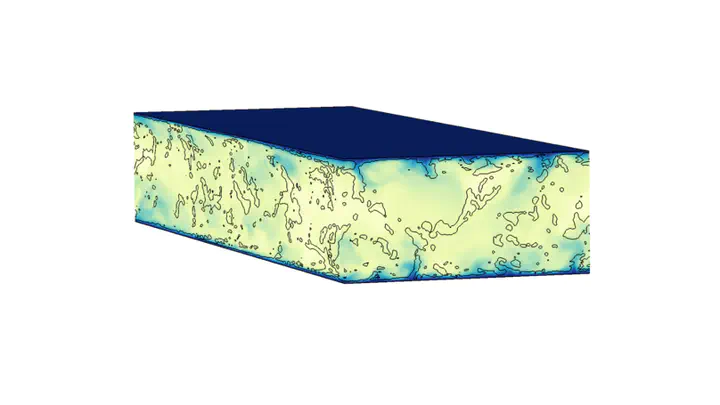 Particle volume fraction contours showing particles reside within the low-speed regions of the flow
Abstract
We investigate the mechanisms by which inertial particles dispersed at semidilute conditions cause significant drag-reduction in a turbulent channel flow at $\mathrm{Re}_\tau=180$. We consider a series of four-way-coupled Euler-Lagrange simulations where particles having friction Stokes number $\mathrm{St}^+ = 6$ or 30 are introduced at progressively increasing mass loading from $M = 0.2$ to 1.0. The simulations show that $\mathrm{St}^+ = 30$ particles cause large drag-reduction by up to 19.74% at $M = 1.0$, whereas $\mathrm{St}^+ = 6$ particles cause large drag increase by up to 16.92% at $M = 1.0$. To reveal the mechanisms underpinning drag-reduction or drag-increase, we investigate the stress distribution within the channel and the impact of the dispersed particles on the near-wall coherent structures. We find a distinctive feature of drag-reducing particles which consists in the formation of extremely long clusters, called ropes. These structures align preferentially with the low-speed streaks and contribute to their stabilization and suppression of bursting. Despite the additional stresses due to the particles, the modulation of the near-wall coherent structures leads to a greater reduction of Reynolds shear stresses and partial relaminarization of the near-wall flow. In the case of the drag-increasing particles with $\mathrm{St}^+ = 6$, a reduction in Reynolds shear stresses is also observed, however, this reduction is insufficient to overcome the additional particle stresses which leads to drag increase.